
Introduction
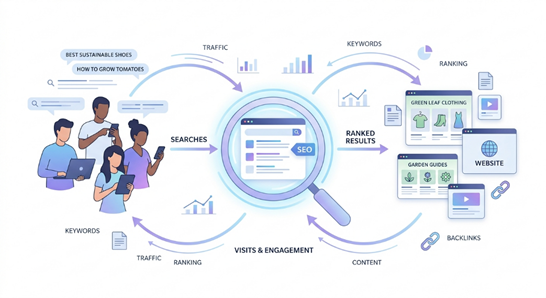
Remember your first day at new school? Nobody knew your name. Nobody knew how smart or talented you were. But slowly – by showing up every day, building real connections – people started noticing you. Your reputation grew. Well, the internet works the same way. Millions of websites get launched every year, each one believing they deserve to be found. But only the ones who understand SEO actually get there.
What is SEO in Digital Marketing? Think of Google as a judge in a competition, where every website is a contestant. SEO is how you make sure that the judge always picks you as a winner.
But why should you care about SEO? Because every single day millions of people are searching what you offer, and without SEO they will never find you, instead they will find your competitor. SEO keeps working for you 24/7. Even while you are sleeping it brings in free, consistent traffic every single day. This blog will do something which most of the other guides fail to do – Explain everything in plain, simple language with zero confusion. By the end of this blog, you will know exactly what search engine is, how it works, Pillars, Types and much more. Consider this as your SEO guide for 2026.
What is SEO [Search Engine Optimization]
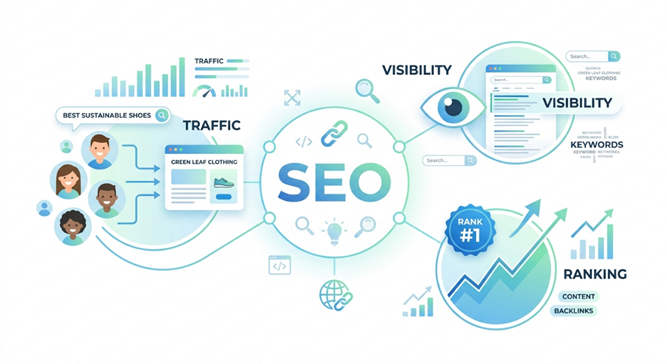
SEO stands for Search Engine Optimization – But, what does that actually mean? Simply put, it’s the process of optimizing your website so that search engines like Google can find it, understand it and rank it higher in search results, without paying for ads.
When someone puts a query on Google, the search engine goes through millions of websites and picks the one it considers most relevant and helpful. It involves a combination of technical optimization, content creation and link building to make sure your website is one of those chosen results.
In today’s digital age, SEO is no longer an option. With over 8.5 billion searches happening on google every day, businesses that invest in SEO have advantage over those that don’t.
Simple enough, right? Now that the foundation is set, lets understand the system SEO is designed to work with – the search engine itself.
What Is Search Engine?
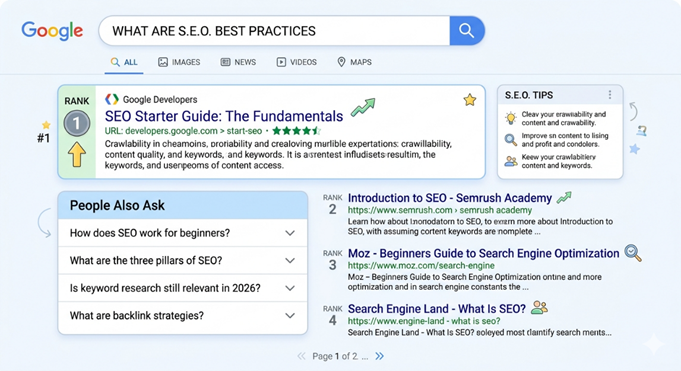
Ever typed a question on Google and got exactly what you were looking for in seconds? That’s search engine at work – it’s a software system designed to search, index and retrieve information from internet and present the most relevant information to the users within seconds.
Today when we say search engines, most people think of Google. And honestly? That’s not wrong. Google holds over 90% of global search market share. But other search engines like Bing, Yahoo, Duck Duck Go and Baidu also play an important role, especially in specific regions and demographic.
But, lets be honest. When was the last time when somebody said ‘let’s Bing it’? Google is the king. And that’s exactly why SEO is built around making Google love your website.
Now that you know what a search engine is – lets go behind the scenes and understand exactly how it works.
How Does Search Engines Actually Work
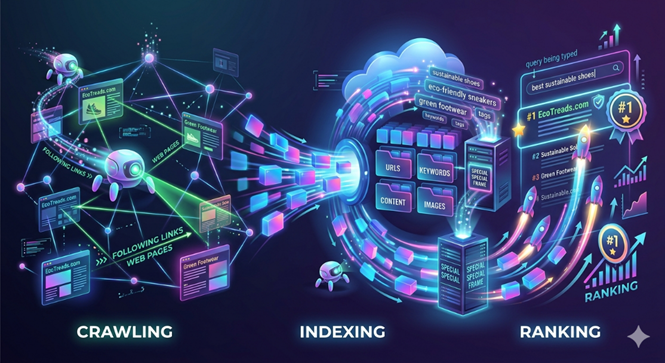
Have you ever wondered what happens in that fraction of a second between typing your query and getting millions of results? The answer is fascinating, and understanding this will completely change the way you think about SEO.
- Crawling:
The first step is crawling – and it works exactly like a spider spinning web.
Search engines uses automated bots commonly known as crawlers to continuously browse the internet and discover new web pages. These bots travel from link-to-link visiting web pages, reading their content, following links and discovering new pages along the way.
Every time a new page is published on internet, these crawlers eventually discover it. They scan everything – from your text to images to page speed, and report everything to Google.
Note: if crawlers can’t reach your page, they can’t index it. And if your page is not indexed, they will never appear in search results.
- Indexing:
After crawling comes indexing – and this is where things get really interesting.
Think of index as Google’s giant digital library, which contains a copy of every webpage it has crawled.
Google doesn’t just save a copy of webpages, it studies it. It looks at everything – keywords, headings, images, links, page speed, mobile friendliness etc. it then files your page under the topic it believes your content is most relevant for.
That’s why quality matters the most in SEO. The clearer your content is, the more accurately Google can index your page and categorize it. Therefore, increasing the chances of your page ranking for the right search queries.
If your page is not in Google index, it simply wont appear in any results. Period.
- Ranking:
The final and the most important step is ranking – and this is where the actual competition begins.
After indexing millions of pages on same topic, Google has to decide which one deserves to be on page one. Google uses a complex algorithm that evaluates over 200 ranking factors to make this decision.
Think of it like a competition with millions of contestants and Google is the judge. It scores every page based on quality of content, page speed, mobile friendliness, backlinks, user experience and relevance to the search query.
The websites with highest score get ranked at top and the rest gets buried in page two and so on, and we all know that nobody visits page two.
This is the entire game of SEO. Understanding what Google scores, you on and optimizing your website to score higher than your competitors, every single time.
To summarize, search engine works in three steps – Crawlers discovers your page, indexing stores and understand your page and ranking decides where your page appears in search results. And SEO is the strategy to make sure you win all three and rank above everybody else.
Now that you know how search engine works, lets talk about how SEO fits in your digital marketing strategy and what they are trying to achieve.
Objectives of SEO in Digital Marketing:
Most people think that the only objective of SEO is to rank higher on Google. But, its just the beginning. SEO has much bigger purpose in digital marketing than most people realize.
Increase Organic Traffic:
Think of organic traffic as people walking into your store because they genuinely heard that its great – not because you paid for a billboard outside.
It refers to visitors who land on your webpage through unpaid search results, meaning they found you naturally on Google without you spending money on ads.
The higher you rank on Google the more clicks you get. The more clicks you get the more people visit your website. More visitors mean more opportunity to grow your business.
The best part? Unlike paid ads that stops the moment your budget runs out- organic traffic keeps flowing as long as your SEO is working.
Improves Search Engine Rankings:
Ranking higher on Google’s search result page directly impacts how many people see and click on your website.
Imagine Google search result as a race. Websites on the top of first page are the winners – getting all attention, traffic and business.
Studies show that first result on page one gets 27% of all clicks, while results on page two gets less than 1%. This is why climbing on top of search results is very important. And SEO make sure that your website is always racing towards the top and stays there. Because in the world of search results, position is everything.
Build Brand Awareness and Credibility
When your website consistently appears on the first page of Google for relevant searches, people start recognising your brand even if they don’t click immediately.
Think about brands you trust most; chances are that you see them everywhere. On Google, Social Media, Recommendations. The constant presence is what built your trust in them.
Repeated visibility builds trust, and trust builds credibility. People are far more likely to do business with brands they have seen multiple times on Google, rather than brands they have not heard of.
Generate Quality Leads & Conversions:
Think about the difference between knocking on doors to sell something versus having interested buyers walk into the stores on their own.
Unlike traditional advertising that shows your products to everyone, SEO attracts people who are already searching for what you offer.
This means the traffic SEO brings is not just high in quantity but high in quality as well. It attracts people who are genuinely interested in your product or service, making them far more likely to convert them into paying customers.
This is why SEO generated leads constantly outperform leads from every other marketing channels.
Enhance User Experience:
A lesser known but equally important objective of SEO is improving user experience.
Google watches over user behaviour very carefully. If people just visit your website and leave immediately, Google assumes your website isn’t useful and leaves immediately. But if visitors stay, engage & explore Google rewards you with higher rankings.
SEO pushes to make your website faster, mobile friendly and valuable. The result is a better experience for every visitor. Which in turn signals Google that your page deserves to be ranked higher.
Achieve Long Term & Sustainable Growth:
Unlike paid advertising that stops showing results once you stop spending – SEO builds long term and sustainable growth.
Paid ads are like buying fruits from store, the moment you stop paying – fruits stop coming. SEO is like a tree you plant once and harvest from it forever.
A well optimised website continues to attract organic traffic, generate leads and build brand credibility month after month without having to spend on ads. This makes SEO as on the highest return on investment strategies in digital marketing.
At its core SEO is designed to do powerful things for your business. Drive organic traffic, improve rankings on Google, build brand’s credibility, generate high quality leads and more. These objectives make SEO as one of the most powerful digital marketing strategies available to any business.
Pillars Of SEO
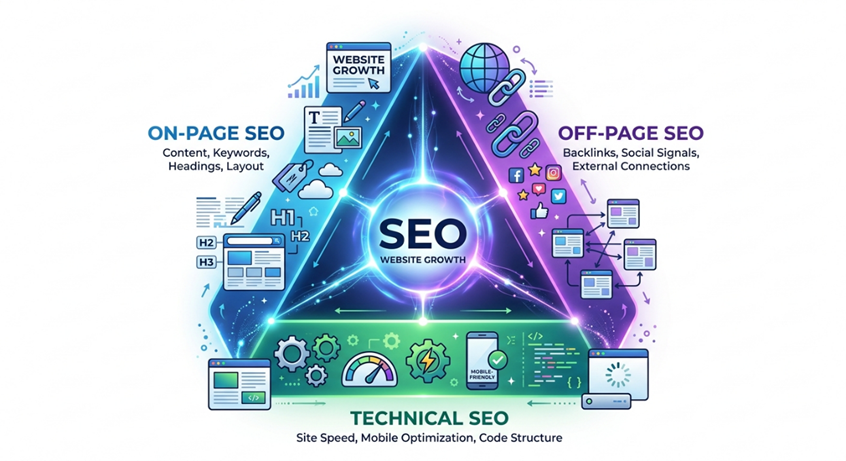
Every successful SEO strategy in the world no matter how complex or advanced it is, built on three fundamental pillars. Remove any one of those and your SEO strategy starts to fall apart. Let’s find out what they are.
The three pillars of SEO are On-Page SEO, Technical SEO & Off-Page SEO. Each one plays a unique yet equally important role in helping your website rank higher on Google. Let’s break down each one of them in detail.
On-Page SEO:
The first pillar is On-Page SEO – and this is where everything begins.
On-Page SEO refers to everything you do directly on your webpage to make it more visible, relevant and valuable, to rank them higher in search results.
Every word, heading, image and links you add falls under On-Page SEO. Here are the key elements which makes up a strong On-Page SEO strategy:
- Keyword research: Before you start writing anything, you need to know what your audience are searching for. Keyword Research helps you find out the exact words and phrases users type on Google, so you can create content that directly matches their search intent.
- Title Tag: It’s the first thing both Google & Users see. A strong title tag with primary keyword will tell Google what you content / page is all about. It also increases the chances of users clicking on your results over others. Title tag must have 50-60 characters.
- Meta Description: Meta description is a short summary that appears below title in search results. It doesn’t directly affect ranking but it improves click through rate, meaning more people will choose your content over others. The character limit is 150-160.
- Headings: headings divide your content into clear sections – making it easier for both Google and users to understand the structure of your page. Every page must have only one clear H1 and multiple H2 & H3 to organize supporting information.
- Content quality: Google’s number 1 priority is useful content and no optimization can save poor content. Google algorithm is designed to reward pages that genuinely help people. Your content needs to be thorough, accurate and original and written with keeping reader’s intent on mind.
- Internal Linking: Internal links connect one page of your website to another. They help Google to discover more of your pages and users to navigate to related content. It helps in distributing authority across your pages which will positively impact your ranking.
- Image Optimization: Google cannot see images but it can read alt text. So, every image on your page should have a short description (alt text) which tell Google what the image is about. Images should also be compressed for fast loading – because slow images hurt both user experience and rankings.
- URL Structure: Your URL should be short, clean & must include your primary keyword. A clear URL tells both Google & users what the page is all about even before they click on it.
When all these elements work together you send a clear message to Google – that your page is exactly what users are looking for. Also, On-Page SEO is a foundation for everything. Get this right & you build a solid base for other SEO pillars.
Technical SEO:
The second pillar is Technical SEO – it’s the process of optimizing the backend structure of your website, so search engines can crawl, index and understand it without any obstacles.
While On-Page SEO concentrates on your content, Technical SEO focuses on your website infrastructure. Here are the key elements of Technical SEO:
- Website Speed: Page speed is one of Google’s most important ranking factors. If a website takes more than 3seconds to load visitors may leave and Google notices. Compressing images, using fast hosting & enabling browser caching are some effective ways to improve website speed.
- Mobile Friendliness: Over 60% of all internet searches happen on mobile devices. Google uses mobile first indexing which means, it primarily evaluates mobile version of your website when ranking. If your website doesn’t function well on mobile, your ranking will be affected.
- SSL Certificates (HTTPS): An SSL certificate change your URL from HTTP to HTTPS, hence making your website secure. Google considers HTTPS as a ranking factor and users trust secure website more. Without it Google can declare your website unsafe driving users away from it.
- XML Sitemap: XML Sitemap is a roadmap of your entire website, listing every page in a structured format. Submitting your sitemap to Google will help crawlers discover your page and index it faster and more efficiently.
- Robots.txt File: It’s a file which tells Google crawlers which page to visit and which page to ignore. It gives you control over what gets indexed helping Google focus on important pages and stop wasting crawl budget on irrelevant ones.
- Crawlability & Indexability: Technical SEO make sure there are no broken links, redirect errors or blocked pages preventing Google from accessing your content. Therefore, it makes sure all pages are crawled and indexed.
- Web Vitals: These are set of Google’s specific page experience metrics like measuring loading speed, interactivity and visual stability. Websites that score well on web vitals outperforms those who don’t.
- Structured Data (Schema Markup): It’s a special code that you add to your website so that Google can understand your content better. It can unlock enhanced search results like FAQ’s, ratings and product details. These rich result attracts more click than standard results.
- Canonical Tags: Canonical Tags tell Google which version of the page is original, preventing duplicate content issues that can confuse the algorithm and split ranking authority across multiple URLs.
Every technical issue on your website is a barrier between your content and Google rankings. Technical SEO removes every single one of them.
Off-Page SEO:
Final pillar is Off-Page SEO, and this is where your websites reputation is built beyond your own pages.
Off-Page SEO refers to all the actions taken outside of your website that influence your search engine rankings – primarily through building backlinks, brand mentions and online authority.
Here are the key elements of Off-Page SEO:
- Backlinks: These are the links from other websites that point to yours, and they are the most important element of Off-Page SEO. Every backlink act as a vote of confidence. The higher – quality backlinks your website earns, the more authority Google assigns to it making your website rank higher.
- Domain Authority: It’s a score that measures the overall credibility and trustworthiness of your website based on its backlink profile. The higher your domain authority, the easier it becomes to rank for competitor keywords.
- Guest Posting: It involves writing content for other websites in your niche, in exchange for a backlink for your website. Its one of the most widely used Off-Page strategies for building authority.
- Social Signals: Social medias may not directly impact rankings, but they increase your contents visibility. This leads to more backlinks which improves your rankings.
- Brand Mentions: When authoritative websites mention your brand by name, it contributes to your overall online reputation and credibility. Brand mentions are recognised by Google as a trust signal.
- Influencer Outreach: Collaborating with influencers in your niche can earn you powerful backlinks and brand exposure. A mention or link from popular influencers can boost both your traffic and domain authority.
- Local Citations: For local businesses getting listed on directories like Yelp and industry specific listing is a crucial Off-Page SEO strategy.
- Forum & Community Participation: Actively participating in relevant online communities like Reddit, Quora helps establish your expertise and can drive traffic to your website. If done authentically it contributes to your brands online authority.
On-Page SEO, Technical SEO & Off-Page SEO. Three pillars, one powerful strategy. Now let’ s explore the types of SEO practices you can use to apply all of this.
Practices Of SEO:
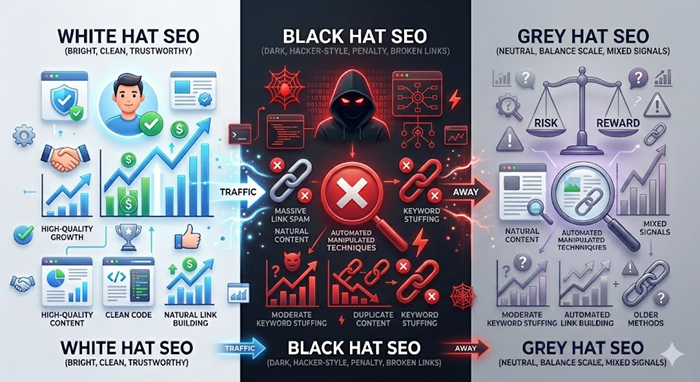
Not all SEO is created equal. Some strategies give you long term success, while some gets you penalised by Google. And some walk a dangerous line in between.
There are three categories of SEO practices that every website owner must know about. White Hat SEO, Black Hat SEO, Grey Hat SEO. Each one takes a completely different approach to rank on Google. Understanding the difference could be the most important SEO decision you ever make.
White Hat SEO:
White Hat SEO is simply doing SEO in the right way. This approach prioritizes the audience first – focusing on creating genuine value through quality content, ethical link building and optimizing your website with full compliance with Google’s guidelines.
White Hat SEO is the gold standard of SEO practices. Every long-term successful website is built on this practice.
The core philosophy of White Hat SEO is simple – create the best possible experience for your user and Google will reward you for it.
Key White Hat SEO practices include:
- High quality content creation.
- Proper keyword research and optimization.
- Ethical link building.
- Technical optimization.
- Positive user experience.
- Honest On Page optimization.
The results of White Hat SEO take time, but they are stable. This is the approach that builds websites which dominates Google for a long time.
Black Hat SEO:
Black Hat SEO refers to SEO practices that violate Google guidelines. While they may boost ranking for short term, they come with an extremely high risk of Google penalties – ranging from ranking drops to complete removal of website from search engines.
Black Hat SEO is everything Google warns you not to do, and for a very good reason.
These techniques are designed to manipulate search engines algorithm and give results quickly, which is exactly why some website owners are tempted by them. But Google’s algorithm are constantly evolving & Black Hat techniques that work today may lead to penalties tomorrow.
Common Black Hat techniques includes:
- Keyword Stuffing.
- Cloaking.
- Buying Backlinks.
- Duplicate Content.
- Hidden Texts & Links.
- Private Blog Networks (PBN’s).
- Doorway Pages.
The bottom line? Black Hat SEO is never worth the risk. Build your website the right way, and you will never have to worry about Google taking it all away.
Grey Hat SEO:
Grey Hat SEO are practices that falls in between White Hat & Black Hat. These are the techniques that don’t really violate Google guidelines, but are not fully approved either.
They carry moderate risk and in case Google algorithm changes Grey Hat SEO can quickly change into Black Hat SEO.
Grey Hat SEO is tempting because its safer than Black Hat & faster than White Hat. But it carries a risk which most people underestimate – Uncertainty.
Common Grey Hat SEO practices include:
- Buying Aged Domains.
- Clickbait Titles.
- Link Exchanges.
- Spinning Content.
- Paying For Reviews.
- Over Optimized For Anchor Text.
Grey Hat SEO is a calculated risk. Some use these techniques and never face consequences, while others loose everything they have built with a single algorithm update. The question is, is the risk worth to take? Now that you know the types of practices of SEO, lets go one level deeper and explore advanced level of SEO that takes your strategy next level.
Advanced Types Of SEO:
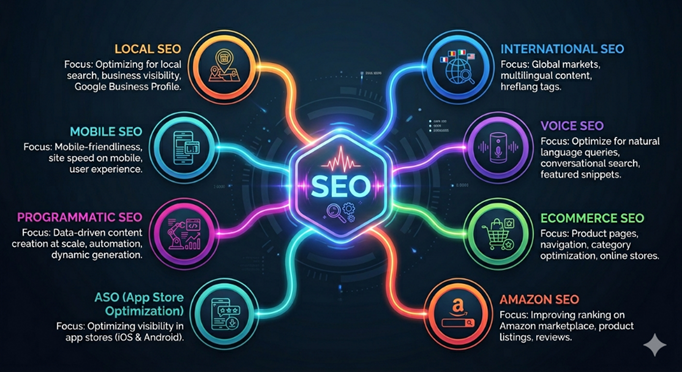
You now understand the foundation of SEO. But here’s where it gets really interesting. Beyond the pillars and basic practices, there’s a whole world of specialised SEO strategies designed for specific goals, platforms & audiences.
Advanced SEO goes beyond basics. Understanding it will give you a significant competitive advantage. While most beginners focus on only optimization, businesses that master these strategies will outperform their competitors. Let’s breakdown each one.
Local SEO:
Ever searched ‘Best Café’s near me’ or ‘Hospitals in Bangalore’? the results at top aren’t there by mistake. Its there because businesses have invested in Local SEO.
Local SEO is the process of optimizing your online presence, to attract more customers from relevant local searches – helping nearby people find your business first when they search on Google.
Local SEO is one of the most powerful strategies for any businesses that serves a specific geographical area – restaurants, salons, clinics, coaching centres – any business with a physical presence or local service area.
Key elements of Local SEO:
- Google My Business Optimization: Your GMB profile is your digital storefront. Complete your GMB profile with accurate business name, phone number, photos, service hours & regular posts, to appear in Google’s local pack.
- Local Keywords: Use location specific keywords like ‘Bakeries in Koramangala’ or ‘SEO agencies in Mumbai’ so that Google will know exactly which area you serve and who it should show your website.
- NAP Consistency: NAP stands for name, address, phone number. Keep them identical across all platforms.
- Local Citations: Getting listed on local directories like Just Dial, Sulekha will build local authority. It will help Google verify that your business is legitimate & trustworthy.
- Location Pages: Creating dedicated, unique pages for each location with relevant local content will help you rank across multiple areas at once.
Local SEO levels the playing field for small businesses. With the right strategies, local businesses can outrank a national brand.
International SEO:
If your business serves customers across different countries and languages, International SEO make sure that it will show right version of your website to right people. It’s the process of optimizing your website to rank effectively in multiple countries and languages.
International SEO is a strategy for businesses who think beyond borders – and it comes with a unique set of challenges that standard SEO doesn’t address.
Key elements of International SEO:
- Hreflang Tags: These tags are pieces of code that tells Google which language or country each page is targeting. This will prevent Google from showing wrong language content to wrong audience.
- URL Structure for International Targeting: There are three main URL structure options for international website – Country Domains, Subdirectories, Subdomains. Choose the right one depending on your business goals & resources.
- Localised Content: True International SEO goes beyond just translating content. So, create content that is culturally relevant, locally accurate and genuinely resonates with audiences of targeted countries.
- Country Specific Keyword Research: Research keywords separately per market, as search term varies significantly across region and language.
- Building Authority in Each Market: Earning backlinks from websites in each target country is essential for ranking in those market, as authority in one market doesn’t carry it over to another.
- Technical Considerations: Handle duplicate content, server location, currency localisation and fast loading speeds for every target country.
International SEO is complex, but for businesses with global ambitions – it’s a strategy that turns a local website into a worldwide revenue generator.
Voice SEO:
Voice SEO is optimizing your content to appear in voice search results. It’s a strategy to make sure your website is the one Google reads out as answer.
Voice search is growing faster than any other search format. It behaves very differently from traditional text search. It’s a strategy to optimize your content specifically for how people talk, not just how they type.
Key elements Of Voice SEO:
- Conversational Keywords: Voice searches are naturally longer and more conversational than typed searches. So, target longer, natural language phrases (long tail keywords) that matches how people actually speak.
- Featured Snippet Optimization: Majority of voice searches answers come directly from Google’s featured snippets. Structuring content to win featured snippets increases your chances of being the answer for voice searches.
- FAQ Content: Voice searches are predominantly question based. Creating FAQ sections that directly answer common question in your niche is one of the most effective Voice SEO strategy.
- Local Voice Search: Significant portion of voice searches are local based queries. Combining Voice SEO with Local SEO is very helpful for businesses with physical locations.
- Page Speed: Voice search results mostly come from fast loading pages. Google prioritize speed for voice search answers, making page speed optimization essential for Voice SEO.
- Structured Data: Use schema markup (especially Speakable schema) to help Google identify your content as ideal for voice results.
- Mobile Optimization: As majority of voice searches happen on mobile, a fully mobile optimized website is a must.
Voice search is not the future- it’s the present. And businesses that optimize it now will have a head start over those who wait.
Ecommerce SEO:
Ecommerce SEO is the process of optimizing an online store to rank higher in search results. It makes your product appear when people search for exactly what you sell.
Ecommerce SEO is built specifically for online stores, and it comes with unique challenges and opportunities that standard SEO doesn’t fully address.
Key elements of Ecommerce SEO:
- Product Page Optimization: Every product page needs unique title, original descriptions, compressed images with alt text, and clean URLs to avoid duplicate content penalties.
- Category Page Optimization: Category pages often receive the highest organic traffic on ecommerce websites. Optimizing these pages with relevant keywords, strong internal linking and clear navigation structure can drive massive organic traffic to your entire product range.
- Buyer Intent Keyword Research: Ecommerce keyword research focuses on purchase intent keywords; terms people use when they are ready to buy. So, we need to target purchase ready keywords like ‘buy speaker online’, that convert far better than informational ones.
- Product Schema Markup: Add schema to show star ratings, prices and availability directly in search results. These enhanced listings increase click through rates and attract more qualified buyers.
- Technical SEO For Large Sites: Large Ecommerce websites face challenges like; duplicate content crawl budget management etc., Addressing these is critical for ranking success at scale.
- Site Speed & Core Web Vitals: Every second of loading delay directly costs sales on ecommerce websites. Fast loading product pages improve both rankings and conversion rates simultaneously.
- User Generated Content: Reviews, ratings and Q&A sections add fresh unique content to product page naturally. This improves SEO while simultaneously increasing buyer confidence and conversion rates.
- Internal Linking Between Products: Linking related products and categories strategically will distribute authority and increase average order value.
Ecommerce targets buyer at the exact moment they are ready to make a purchase, making it one of the highest return on investment strategies available for any online retailers.
Amazon SEO:
Amazon SEO is optimizing product listings on Amazon’s marketplace to rank higher in Amazon’s internal search results, which will increase product visibility and driving more sales.
Amazon SEO is completely separate from Google SEO. Amazon operates its own powerful search engine called the A9 algorithm, which is designed specifically to connect shoppers with products they’re most likely to buy.
Key elements of Amazon SEO:
- Product Title Optimization: Amazon product title is the most important ranking factor. So, Include your primary keyword, brand, features, size & colour in a natural, readable title format.
- Keyword Research For Amazon: Amazon keyword research is different from Google keyword research. Amazon focus on exact purchase-intent terms shoppers use, including misspellings and competitor brand terms.
- Backend Search Terms: Amazon allows sellers to add hidden keywords in the backend of their listings. These are the search terms that doesn’t appear for shoppers but are indexed by Amazon’s algorithm. Maximizing these with relevant keywords that couldn’t fit in title or description is a critical Amazon SEO strategy.
- Bullet Points & Product Description: Amazon’s bullet points are your most visible content after the title. They should highlight your product’s key benefits and not just features.
- Product Images: Use high-quality, multi-angle and lifestyle images to boost conversions, which is one of Amazon’s strongest ranking signals.
- Reviews & Ratings: Amazon’s algorithm heavily favours products with more reviews and higher ratings. Actively encouraging genuine reviews via follow-ups is very important.
- Pricing & Conversion Rate: Amazon’s algorithm is ultimately designed to maximize sales. Competitive pricing combined with strong visuals and copy drives conversions, which directly improves rankings.
- Amazon FBA & Prime Eligibility: Products fulfilled through Amazon FBA and eligible for Prime shipping consistently rank higher as they offer the fast delivery experience that Amazon prioritizes for its customers.
Amazon SEO is unique because it sits at the intersection of SEO and conversion optimization. Ranking and selling are directly connected on Amazon. The better your product converts the higher Amazon ranks it which drives even more sales.
ASO (App Store Optimization):
App store optimization is the process of optimizing a mobile app’s listing on Apple App Store or Google Play Store to rank higher in app search results and increase organic downloads.
With over 5million apps available on both App store and Play Store – getting your app discovered organically is one of the biggest challenges in mobile marketing. ASO is the solution.
Key elements Of ASO:
- Apple Title & Subtitle: Your app title is the most important ASO ranking factor. Include your primary keyword in the title and use the subtitle for secondary keywords to value your position.
- Keyword Field: Both app stores provide a dedicated keyword field which is hidden from users but indexed by the algorithm. Maximizing this field with highly relevant, non-repetitive keywords which will target your user search is critical for discoverability.
- App Description: App description has two purposes – one is to convince user for download and the other is to signal relevance to app store algorithm. First three lines are most important as they are visible above “read more” fold and will immediately communicate your app’s core value.
- App Icon: App icon is the first visual impression users have of your app. A distinctive, professional icon boosts click-through rate in search results, which directly impacts your ASO ranking.
- Screenshots & Preview Video: Compelling visuals are the strongest conversion tools in your listing. They show users exactly what the app experience looks like and increase the percentage of people who download after viewing your listing.
- Ratings & Reviews: App store algorithms heavily favour apps with more ratings and higher average scores. Encouraging satisfied users to leave reviews — through well timed in app prompts is one of the highest impacts ASO strategies available.
- Downloads & Engagement: Download velocity, session length, retention, and crash rate all factor into rankings, rewarding well-designed apps over time.
- Regular Updates: Apps that are updated regularly signal to both the algorithm and users that the developer is actively maintaining and improving the product which impacts ranking and user trust.
ASO is a strategy which will turn your app from one in a million to the one which user actually find, download and keep using.
Programmatic SEO:
It’s a practice of creating large numbers of web pages using templates and data to target thousands of long tail keywords simultaneously and capture massive organic traffic.
Programmatic SEO is one of the most powerful and most misunderstood advanced SEO strategies available. The concept is straight forward – identify a large set of related long tail keywords that follow a predictable pattern, then create a template that generates unique, valuable pages for each keyword combination automatically.
Key elements of Programmatic SEO:
- Identifying Scalable Keyword Patterns: The foundation of Programmatic SEO is finding keyword patterns that follow a consistent formula like “Service In City” Example: SEO Services In Bangalore, SEO Services In Mumbai etc., where the variable changes but the structure remains the same.
- Building a Content Template: Create dynamic page templates that populate with unique data per keyword, ensuring real value over thin repetitive content.
- Sourcing Unique Data: The key difference between successful Programmatic SEO and spam is unique data. Each programmatically generated page must contain genuinely useful, differentiated information pulled from a database, API, or proprietary data source.
- Technical Infrastructure: Build robust systems for database management, dynamic page generation, and crawl budget control so Google can index thousands of pages efficiently.
- Quality Control: Every generated page must genuinely serve the user, as Google penalizes thin programmatically generated content that lacks real value.
When done correctly Programmatic SEO is one of the most scalable organic growth strategies in Digital Marketing. And when done poorly it results in Google Penalties.
Mobile SEO:
Mobile SEO is the process of optimizing your website to deliver a fast, seamless, and user-friendly experience on mobile devices. It ensures, performance in mobile search results where the majority of searches happen.
Mobile SEO is non-negotiable in 2026. Google uses mobile first indexing, which means it evaluates and ranks the mobile version of your website primarily. If your mobile experience is poor then your ranking suffers across every device & not just mobile.
Key elements of Mobile SEO:
- Responsive Design: Your site must automatically adapt to any screen size, as it’s the absolute foundation for mobile rankings in 2026.
- Mobile Page Speed: Pages taking over 3 seconds to load see dramatically higher bounce rates; use image compression, lazy loading, and fast hosting.
- Touch Friendly Navigation: All buttons and links must be large enough to tap accurately, as tiny/closely spaced elements drive visitors away immediately.
- Readable Text Without Zooming: Text must be large enough to read comfortably without pinching, as small text signals poor mobile UX to Google.
- AMP Pages: Accelerated Mobile Pages create ultra-fast loading versions of content-heavy pages, significantly improving mobile user experience.
In 2026 — your mobile website IS your website. Because that’s where the of your audience experiences it. Mobile SEO isn’t an add on — it’s the foundation.
And that covers every advanced type of SEO you need to know. From Local SEO to Programmatic SEO — each one is a powerful strategy designed for a specific goal, platform, and audience.
Conclusion:
SEO is not a trick. It’s not a shortcut. And it’s definitely not optional in 2026. Now you understand not just what SEO is, but how search engines work, why SEO matters, what pillars hold it together, which practices to follow, and which advanced strategies apply to your specific goals.
SEO is one of the most valuable skills you can develop as a business owner, marketer, or content creator in 2026.
In this guide — you’ve covered everything from the fundamentals to the advanced. What SEO is. How search engines work. The objectives of SEO. The three pillars. The types of practices. And the advanced SEO strategies that specialists use to dominate specific markets.
SEO is not a one-time task. It’s an ongoing commitment to creating value, building trust, and improving consistently.
The first page of Google isn’t reserved for the biggest budgets or the most well-known brands. It’s reserved for the websites that best serve their audience — consistently, authentically, and strategically. That website can be yours.
If this guide helped you understand SEO better — share it with someone who needs it. One share could completely change someone’s digital journey.https://www.coursera.org/articles/seo-marketing
FAQ’s:
- How to do SEO for beginners?
Starting SEO as a beginner comes down to four things — research, create, optimize, and build.
Research what your audience are searching for. Create a content that answers these queries better than anybody else. Optimize every page for both humans & Google. At last build backlinks that tell Google that your website is trustworthy.
Set up Google Search Console to track your progress. Stay patient as SEO takes time. Also, be consistent as consistency is the only strategy that never fails.
- What are the most important SEO ranking factors?
Google’s most important ranking factors in 2026 are content quality, backlinks, Core Web Vitals, mobile friendliness, page speed, on-page optimization, user engagement signals, HTTPS security, domain authority, and content freshness.
- How long does SEO take to show result?
Honestly SEO takes time. Most website starts showing early results between 3 to 6 months. significant results are shown between 6 to 12 months of consistent effort.
- Which is better? SEO or Paid Ads.
The honest answer — it depends on your timeline and goals. Need results tomorrow? Paid Ads. Building something that lasts? SEO.
Paid Ads deliver immediate visibility — but stop the moment your budget runs out. SEO takes 3 to 12 months to show results — but those results compound and continue growing long after the initial investment.
The smartest strategy? Use both. Paid Ads for immediate traffic. SEO for long term sustainable growth. Together — they create the most powerful digital marketing combination available.
- What are Common SEO mistakes to avoid?
The most common SEO mistakes to avoid are targeting overly competitive keywords too early, ignoring search intent, neglecting technical SEO, publishing thin content, keyword stuffing, building low quality backlinks, ignoring mobile optimization, not tracking results through Google Search Console, and expecting results too quickly.